Smarter Paws Academy
Last updated: November 2026
This guide was written by the Smarter Paws team with AI help. Its sources are linked on this page.
Quick answer
Puppy blues is the name owners use for the stress, worry, frustration or regret that can follow bringing a puppy home. A 2024 study built the first questionnaire to measure it, using answers from Finnish dog owners about 1,801 dogs (Ståhl et al., 2024).
You are far from alone. In that survey, 45.1% of owners said they had significant negative feelings during their dog’s puppyhood.
For most people it passes. Owners of 1- to 2-year-old dogs scored their feelings much lower now than during the puppy months, and the researchers describe puppy blues as “mostly transient” (Ståhl et al., 2024).
If your low mood doesn’t lift, or it’s getting worse, talk to your doctor. If you are in crisis in the US, you can call, text or chat with the 988 Suicide & Crisis Lifeline, free and confidential, 24/7 (988 Lifeline).
What are puppy blues?
Puppy blues describes a stretch of distress after getting a puppy: worry, frustration, irritation, strain, tiredness or regret. The 2024 study found three parts to it, which it named Anxiety, Frustration and Weariness (Ståhl et al., 2024).
- Anxiety: self-doubt, feeling you’re not a good enough owner, and worry about your puppy’s well-being and development.
- Frustration: a general sense of dissatisfaction, irritation with the puppy, and questioning or regretting the choice to get one.
- Weariness: tiredness, feeling overloaded, and the strain of a daily routine that has changed overnight.
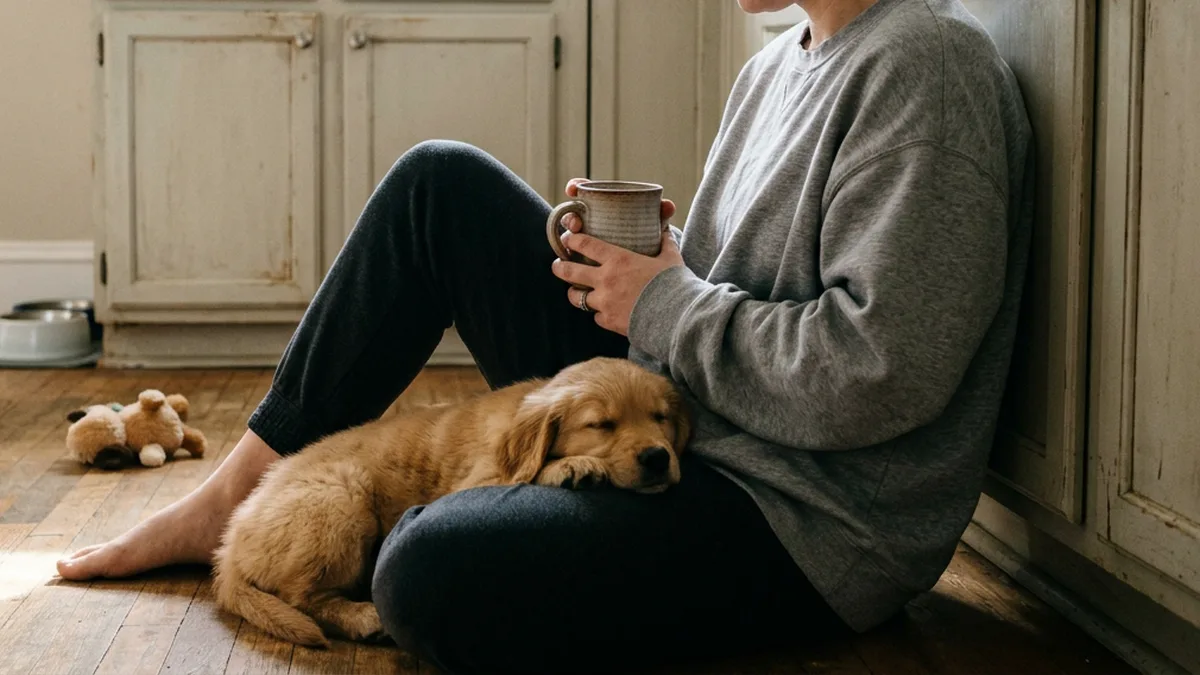
It is a description, not a diagnosis. The researchers compare puppy blues to the “baby blues” some new parents feel, and their questionnaire is a research tool. If what you feel matches a lot of the list above, that is a reason to look after yourself and ask for help, not a sign you are a bad owner.
How long do puppy blues last?
For most owners, weeks to months; for some, longer. Among the owners in the 2024 survey who had significant negative feelings, 20.3% said they lasted less than a month, 31.0% said 1 to 5 months, 29.5% said six months to a year, and 19.3% said more than a year (Ståhl et al., 2024).
These numbers come with limits. Most owners in the survey were Finnish women, they were recruited through social media, and many were remembering a puppyhood several years back. The researchers also found that memories of the puppy months grew more positive with time.
When does it get better? Often as the routine settles and your puppy grows. The owners of 1- to 2-year-old dogs in the study rated all three parts lower for the present than for the puppy period. The practical steps below aim at the parts you can change this week.
Is it normal to regret getting a puppy?
Regret is common enough that researchers put it on the list. “Did you question or regret your choice to get a puppy?” is one of the questions in the 2024 puppy blues questionnaire (Ståhl et al., 2024).
Many owners find it harder than they expected. In a 2025 UK study of 382 adult caregivers in families with a puppy, 37.3% said living with a puppy was harder than they expected (Belshaw et al., 2025). The study also found that first-time owners were more likely than experienced owners to find interactions between their children and the puppy challenging.
Feeling regret doesn’t mean you made a mistake. It often means you are tired and the puppy is doing normal puppy things, like biting, waking at night and toileting indoors, all at once. Most of those have a training answer.
What helps with puppy blues: a one-week reset
Fix the parts of the day that wear you down most, one at a time. These steps are for the dog side of puppy blues. They work alongside looking after yourself, and they don’t replace it.
- Write down your puppy’s day. Meals, toilet trips, naps and play, at the same times every day. Our puppy schedule has sample days by age.
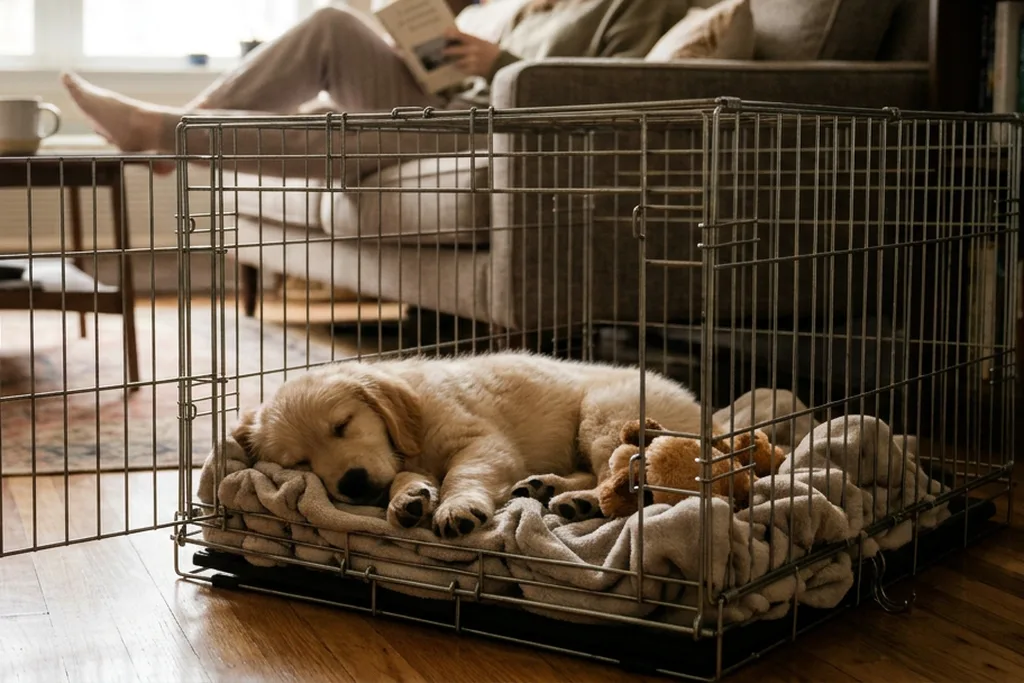
- Plan naps. See our crate training guide.
- Pick the one behavior that hurts most and work on it first. For most owners it’s biting: our puppy biting guide has the method.
- Keep training sessions short. A few minutes, a few times a day, using rewards. Our puppy training guide shows where to start.
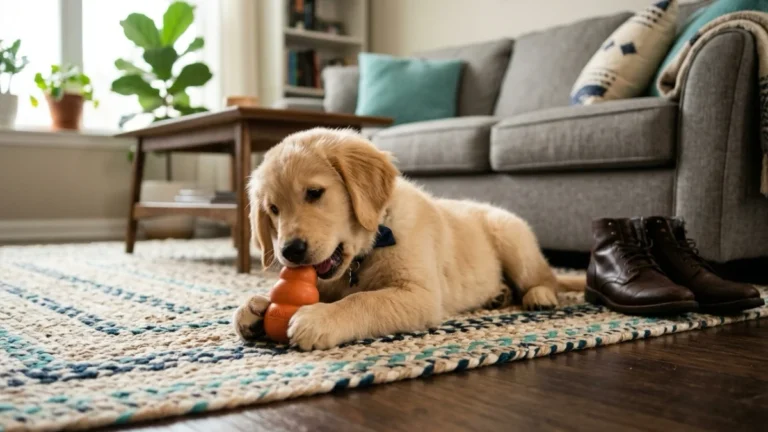
- Give your puppy safe things to chew, so you can sit down without guarding the furniture. See our puppy chew toys guide.
- Share the load. Split puppy jobs between the people at home, by time of day. In the 2025 UK study, families described negotiating who does the caring as one of the main challenges (Belshaw et al., 2025).
- Get outside help for training. A puppy class or a trainer who uses only reward-based methods can take a problem off your plate. AVSAB’s guide “How to Choose a Trainer” lists the green and red flags (AVSAB).
Look after your own basics too: sleep when you can, eat, and keep one thing in your week that is yours. If the steps above don’t lift how you feel, talk to your doctor.
When is it more than puppy blues?
Talk to your doctor if your low mood lasts, gets worse, or stops you doing everyday things. The 2024 researchers compare puppy blues to the “baby blues”, which in some new parents develop into a longer-lasting condition that needs help. They also found that owners with higher puppy blues scores tended to report more anxiety and depression symptoms later (Ståhl et al., 2024).
If you are thinking about harming yourself, reach out now. In the US, call or text 988, or chat at 988lifeline.org, to reach a 988 Lifeline counselor anytime, day or night. It’s free and confidential (988 Lifeline).
If you or someone else is in immediate danger, call 911.
Thinking about rehoming your puppy?
Rehoming can be the kind choice for some families, and deciding it is not a failure. If you are considering it, take these steps in order:
- Talk to the breeder or rescue you got your puppy from. Check your contract or adoption agreement first: many say the dog should go back to them.
- Name the problem. If one behavior is behind the decision, a reward-based trainer may be able to help with it. If the behavior is new or sudden, see your vet, since pain or illness can change behavior.
- If the breeder or rescue can’t take your puppy, contact an established local shelter or rescue and ask how they rehome dogs.
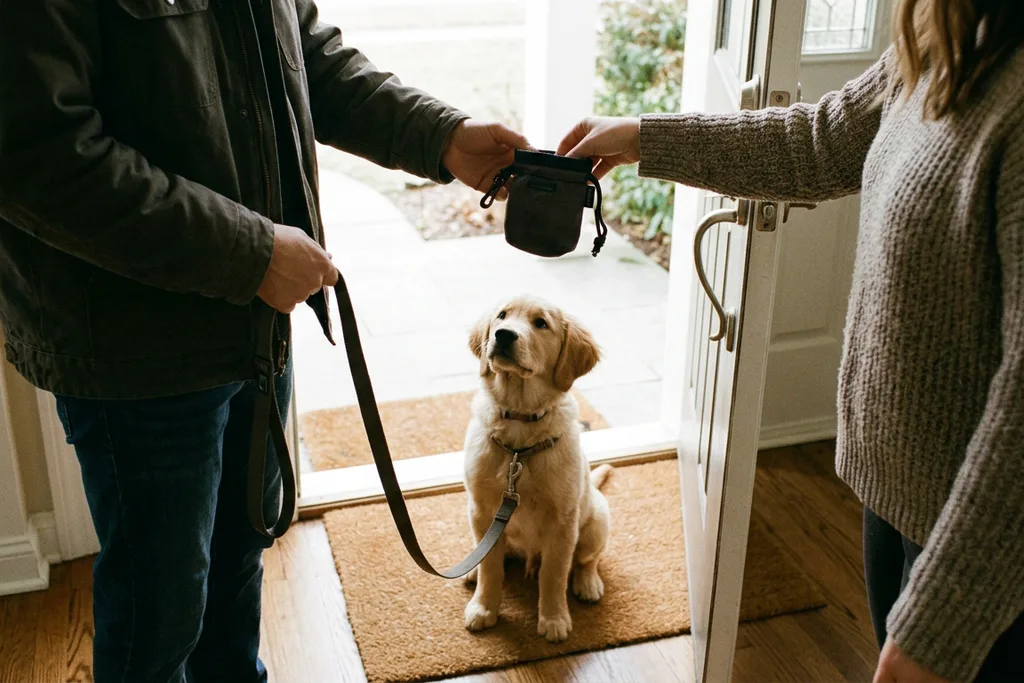
- Give the new home everything you know: the routine, the food, what your puppy loves and what it finds hard.
FAQ: puppy blues
How long do puppy blues last?
For many owners, less than six months, but it varies. In a 2024 survey of Finnish dog owners who had significant negative feelings during puppyhood, 51.3% said they lasted less than 5 months, and 19.3% said more than a year (Ståhl et al., 2024). The study was mostly women recalling the past, so treat the numbers as a guide. If your feelings aren’t easing, talk to your doctor.
Is puppy blues real?
Yes, in the sense that researchers can now measure it. A 2024 study built and tested the first puppy blues questionnaire, using answers about 1,801 dogs, and found it reliable (Ståhl et al., 2024). It is not a medical diagnosis. The researchers describe it as a temporary stretch of distress after getting a puppy, made up of anxiety, frustration and weariness.
Is it normal to feel overwhelmed with a new puppy?
Yes, it’s common. In the 2024 Finnish survey, 45.1% of owners said they had significant negative feelings during their dog’s puppyhood (Ståhl et al., 2024), and in a 2025 UK study, 37.3% of caregivers found life with a puppy harder than expected (Belshaw et al., 2025). A fixed daily routine and help with the hardest behavior are good places to start.
Can puppy blues turn into depression?
Puppy blues itself is described as temporary, but talk to your doctor if your low mood lasts or gets worse. The 2024 study found that owners with higher puppy blues scores tended to report more anxiety and depression symptoms later, though the study can’t say one caused the other (Ståhl et al., 2024). In the US, the 988 Lifeline is there 24/7 by call, text or chat.
Should I rehome my puppy because of puppy blues?
Give yourself time and support first, because for most owners the feelings ease. Owners of 1- to 2-year-old dogs in the 2024 study rated their feelings much lower than during the puppy months (Ståhl et al., 2024). If you still decide to rehome, start with your breeder or rescue. Deciding to rehome is not a failure.
Sources
- Ståhl A, Salonen M, Hakanen E, Mikkola S, Sulkama S, Lahti J, Lohi H. Development and validation of the puppy blues scale measuring temporary affective disturbance resembling baby blues. npj Mental Health Research. 2024;3(1):27. doi:10.1038/s44184-024-00072-z. Open access.
- Belshaw Z, Brand CL, O’Neill DG, Packer RMA. More than just one man and his dog: The many impacts of puppy acquisition on the mental health of families including children in the UK. PLoS One. 2025;20(9):e0331179. doi:10.1371/journal.pone.0331179. Open access.
- 988 Suicide & Crisis Lifeline. 988lifeline.org.
- American Veterinary Society of Animal Behavior (AVSAB). Position statements, including How to Choose a Trainer. avsab.org/resources/position-statements.
Sandie Calloway is the pen name of the Smarter Paws Academy team. How we write