
Loose leash walking means your dog strolls beside you with a relaxed, J-shaped leash, no dragging and no choking. It is the skill that turns a daily chore into a walk you both look forward to. As a certified professional dog trainer, I can tell you that pulling is not stubbornness, it is a natural reflex, and you can fix it with kindness instead of force. This guide gives you the exact 5-step method I teach.
We will cover why dogs pull, the gear that helps without hurting, and a simple positive plan you can start on your next walk. No prong collars, no leash jerks, no fighting your dog. Just clear communication that makes walking politely the most rewarding choice for your dog.
Smarter Paws Academy is reader-supported. When you buy through links on our site, we may earn an affiliate commission at no extra cost to you. As an Amazon Associate, I earn from qualifying purchases. Thank you for your support!
Last Updated: September 2026. This guide is regularly reviewed for accuracy by Sandie Calloway, CPDT-KA.
Important Behavior Disclaimer
The information in this article is for educational purposes and reflects my experience as a certified dog trainer. If your dog lunges, barks, or reacts aggressively toward people or dogs on walks, that is leash reactivity and may need tailored support. Please work with a certified professional dog trainer or veterinary behaviorist for reactivity beyond simple pulling.
Key Takeaways: Loose Leash Walking
- Pulling is a reflex, not defiance. Dogs naturally push against pressure, so leash jerks make pulling worse, not better.
- A front-clip harness helps instantly. Gear like the Easy Walk or Front Range gently reduces pulling while you train.
- Reward the position you want. Pay your dog for walking beside you, and they will offer it more often.
- Stop when the leash tightens. Teach that pulling stops the walk and a loose leash keeps it going.
Prefer to Listen? An Audio Overview
For a practical walk-through of loose leash training, press play below.
Runtime: 1:12
View Full Audio Transcript
Narrator: Welcome to the Smarter Paws Academy audio overview. Pulling on the leash might be the number one complaint from dog owners. Sandie, why do dogs do it?
Sandie Calloway: It is mostly a reflex. When a dog feels pressure on the leash, their instinct is to lean into it, not away. It is called the opposition reflex. So when we yank back, we are actually triggering the dog to pull harder. We are fighting biology.
Narrator: So what works instead?
Sandie Calloway: Two things together. Good gear and good rewards. A front-clip harness gently turns your dog back toward you instead of choking them, so it takes the pressure off right away. Then you reward your dog for being in the spot you want, next to your leg. You pay for the good position.
Narrator: And the classic advice to just stop walking?
Sandie Calloway: It works, and it is part of my plan. A tight leash stops the walk, a loose leash keeps it going. Your dog figures out that pulling gets them nowhere, literally. Be a tree, then reward when they come back to you.
Narrator: Good gear, good rewards, and patience.
Sandie Calloway: That is the whole method. Walks go from a wrestling match to the best part of your day.
Table of Contents
Why Does My Dog Pull on the Leash?
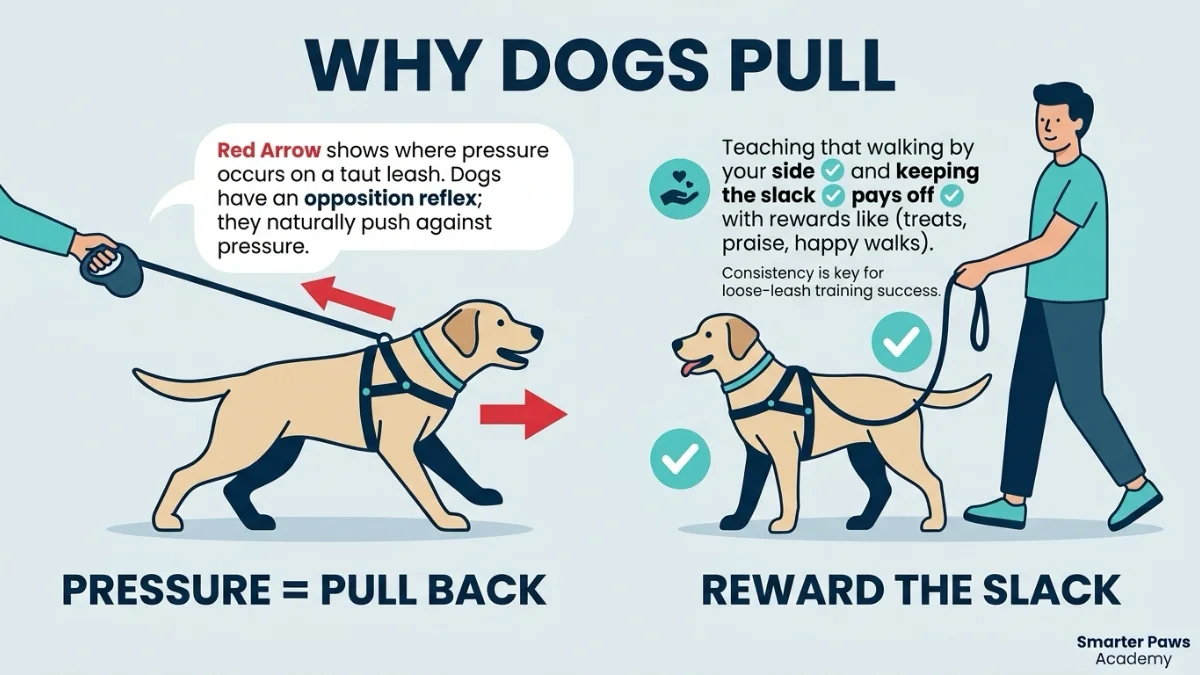
Dogs pull on the leash mostly because of a natural response called the opposition reflex. When a dog feels steady pressure, their instinct is to lean and push against it, not to yield. This is why yanking back on the leash usually makes a dog pull even harder, since you are triggering the very reflex you want to stop. The leash tension itself becomes part of the problem.
The second reason is simple: the world is exciting and dogs walk faster than we do. Every sniff, squirrel, and lamppost is a reward waiting ahead, and pulling has probably gotten your dog there before. In that sense your dog has been trained, by thousands of walks, that pulling works. We are not breaking a bad dog, we are changing a well-practiced habit.
Understanding these two causes points straight to the solution. You remove the pressure that fuels the reflex with better gear, and you make staying near you more rewarding than charging ahead. The AVSAB is clear that reward-based methods, not corrections, are the effective and humane path here. Kindness and biology are on the same side.
What Is the Best Gear for Loose Leash Walking?
The best gear for pulling is a well-fitted front-clip harness paired with a standard leash. A front clip sits on your dog’s chest, so when they surge ahead the harness gently turns them back toward you instead of letting them dig in. This takes pressure off your dog’s throat and gives you a management win from the very first walk. Gear does not replace training, but it makes training possible.
Avoid tools that work through pain or fear, including prong collars, choke chains, and shock collars. They can suppress pulling by hurting your dog, but they damage trust and can worsen fear and reactivity. A good harness achieves calm walking through better mechanics, not discomfort. My guides on why aversive collars backfire explain the science if you want the deeper case.
Best Budget Front-Clip: PetSafe Easy Walk Harness
The PetSafe Easy Walk is the most widely recommended front-clip harness for a reason. The chest strap clips at the sternum, so a pulling dog gets gently redirected sideways instead of powering forward. Trainers reach for it constantly because the pulling reduction is immediate and it is budget-friendly. It is my top starter pick for most dogs who pull.

- Effective No-Pull Solution: The PetSafe Easy Walk Harness helps create pull-free walks by using a martingale loop design…
- Designed for Comfort & Fit: Features adjustable comfort straps and a breathable harness design with less coverage, keepi…
- Simple to Use & Trainer Recommended: Includes an easy color-coded fit and quick-snap shoulder buckles for fast on-and-of…
Best All-Around: Ruffwear Front Range Harness
The Ruffwear Front Range is my pick for comfort and durability on longer walks. It offers both front and back leash attachment points, so you get training flexibility as your dog improves. Padded chest and belly panels prevent rubbing, and four adjustment points dial in a precise fit. For active dogs and daily hikers, it is worth the step up.

- DUAL LEASH ATTACHMENT POINTS. Features an aluminum V-ring on the back and reinforced webbing at the chest. Gives you opt…
- FIND THE RIGHT FIT WITH EASE. Not sure which size to choose? Check out our sizing chart image and how-to-fit video to he…
- FOAM-PADDED CONSTRUCTION. Built with closed-cell foam padding in the chest and belly panels. This provides cushioned sup…
Must-Have Helper: A Hands-Free Treat Pouch
A treat pouch is the small tool that makes loose leash training actually work. Fast access to rewards lets you pay your dog the instant they are in the right position, and timing is everything in positive training. Fumbling in a pocket means you miss the moment and slow the learning. Clip one on before every training walk.

- 【Train Like a Pro】Heouvo dog treat pouch and clicker kit are designed to help you train your dog like professionals. Wit…
- 【Compact Body, Large Capacity】Compared to other bulky treat bags, our treat pouch is very compact (5*4*2inch), but can h…
- 【Food-Grade Silicone Material】Heouvo training bag is made of safe and harmless food-grade silicone that is free from bis…
How Do You Train a Dog to Walk on a Loose Leash?
You train loose leash walking by rewarding the position you want and stopping forward motion when the leash tightens. The plan below combines management gear with clear, positive feedback so your dog learns that a slack leash is what moves the walk forward. Practice in a boring, low-distraction place first, like your hallway or backyard. Here is my 5-step method.
Step 1: Start in a calm space. Begin indoors or in your yard where there is little to pull toward. Success comes easier when the environment is not competing for your dog’s attention.
Step 2: Reward the sweet spot. The moment your dog is beside your leg with a loose leash, mark it with a “yes” and treat at your seam. You are showing your dog exactly where the good things happen.
Step 3: Be a tree when they pull. The instant the leash goes tight, stop moving completely and wait. When your dog releases the tension or looks back at you, reward and walk on, so pulling stalls the walk and slack restarts it.
Step 4: Add the turn. If your dog forges ahead, calmly change direction so they follow you. This keeps them checking in with you rather than towing you down the block.
Step 5: Build up distractions slowly. Once your dog is reliable in calm settings, practice near mild distractions, then busier ones. Raise the treat value as the distractions increase, and keep sessions short and upbeat. Keep a pouch of small, soft training treats on you, and if you use a marker, my clicker training guide and hand signals guide show how to make each reward crystal clear.
What Mistakes Make Leash Pulling Worse?
The biggest mistake is letting pulling work, even sometimes. If your dog pulls toward a sniff and reaches it, they just got paid for pulling, which strengthens the habit. Consistency is what teaches your dog that only a loose leash moves them forward. One “sometimes it works” walk can undo several good ones.
The second mistake is relying on gear alone and skipping the training. A front-clip harness reduces pulling, but it does not teach your dog where to walk on its own. Use the gear to manage while you actively reward the position you want. The harness is the training wheels, not the bike.
The third mistake is going too far, too fast, into hard environments. Starting leash training on a busy street sets your dog up to fail against overwhelming distractions. Build the skill in easy places first, then raise the difficulty gradually. Set your dog up to win and the progress compounds.
Frequently Asked Questions About Loose Leash Walking
How long does it take to stop a dog from pulling?
Most dogs show clear improvement within two to four weeks of consistent, positive practice. A front-clip harness reduces pulling immediately, while the trained habit builds over those weeks. The timeline depends on how long your dog has practiced pulling and how consistent every walker is. Short, frequent training walks speed things up.
Are front-clip harnesses better than back-clip?
Front-clip harnesses are generally better for dogs that pull, because the chest attachment gently redirects them back toward you. Back-clip harnesses are comfortable but can actually make pulling easier by engaging the opposition reflex. Many harnesses, like the Ruffwear Front Range, offer both clips for flexibility. Use the front clip while training, then switch as your dog improves.
Should I use a retractable leash for training?
No, retractable leashes work against loose leash training because they constantly reward pulling with more length. A standard four to six foot leash gives you clear, consistent feedback and better control. Save retractable or long lines for open-space sniffing time, not for teaching polite walking. Consistency in leash length helps your dog learn faster.
Why does my dog walk fine then suddenly pull?
Sudden pulling is usually triggered by a specific reward ahead, such as a smell, another dog, or a squirrel. Your dog has learned that pulling gets them to exciting things faster. Raise your treat value near known triggers and reward check-ins before your dog locks on. Anticipating the trigger is the key to staying ahead of the pull.
Can an older dog learn loose leash walking?
Yes, dogs of any age can learn to walk politely on a loose leash. Older dogs often focus well and may have calmer energy, which helps. The same positive method of rewarding position and stopping for tension works regardless of age. Patience and consistency matter far more than how old your dog is.
Is it too late if my dog has pulled for years?
It is not too late, though a long-practiced pulling habit takes more consistency to change. Pair a front-clip harness with the reward-based method and commit to not letting pulling work. Progress may be slower than with a puppy, but improvement is very achievable. Every consistent walk chips away at the old habit.
Your Next Walk Can Be the Start of Better Ones
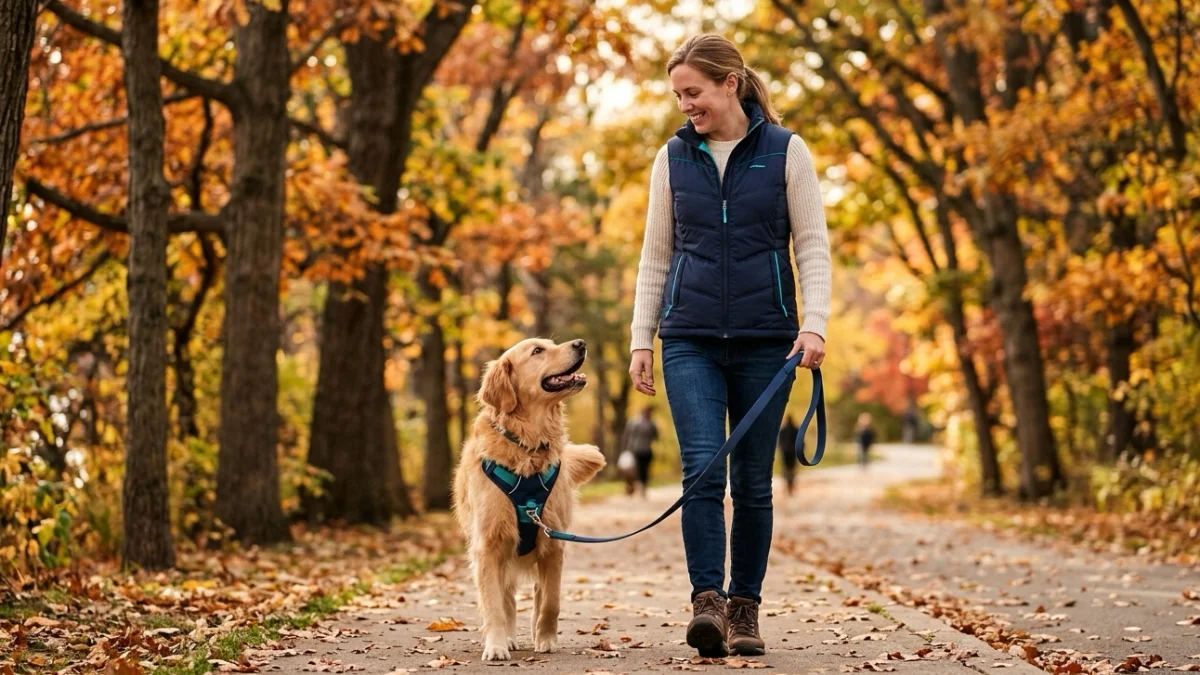
A calm, loose leash walk is not a fantasy, it is a skill any dog can learn with the right gear and a little patience. When you stop fighting your dog’s reflexes and start rewarding the walking position you want, the whole outing changes. Pulling fades because staying beside you finally pays better.
Fit a front-clip harness, load your treat pouch, and try the 5-step method on your very next walk in a quiet spot. Reward the sweet spot, be a tree when the leash tightens, and build up slowly from there. The relaxed, happy walks you have been picturing start with this one kind, consistent session.