Smarter Paws Academy
Quick answer
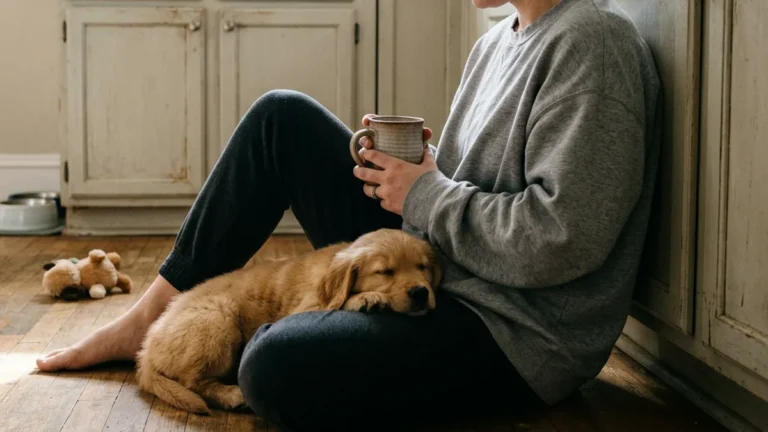
If your puppy is chewing everything in sight, or eating everything outside, that’s normal puppy behavior, and you can steer it. Puppies chew to explore and to ease the pain of incoming teeth, and dogs of every age chew to keep busy (ASPCA). So the goal isn’t a puppy who never chews. It’s a puppy who chews the right things.
The plan: puppy-proof your home, give a variety of chew toys and rotate them, watch your puppy closely, and trade for anything they shouldn’t have instead of chasing.
If your puppy may have swallowed something they shouldn’t, call your vet now. Don’t wait for signs, and don’t try a home remedy.
Why do puppies chew everything?
Puppies explore the world with their mouths. While their adult teeth come in, chewing also eases teething pain, and the ASPCA says this intense chewing phase usually ends by about six months of age. Chewing also fights boredom and can relieve mild anxiety or frustration (ASPCA).
Chewing never stops completely, and it isn’t meant to. The ASPCA calls it perfectly normal for dogs of all ages: it keeps jaws strong and teeth clean. What your puppy has to learn is what’s theirs to chew, and the ASPCA’s advice is to teach that in a gentle, humane way.
If your puppy chews mostly or only when left alone, and also whines, barks, paces or has accidents while you’re out, it may be separation anxiety rather than ordinary chewing (ASPCA). Our dog separation anxiety guide explains what helps.
If your puppy keeps chewing or licking their own paws or tail, that’s a different question from chewing things: ask your vet.
What can puppies chew on safely?
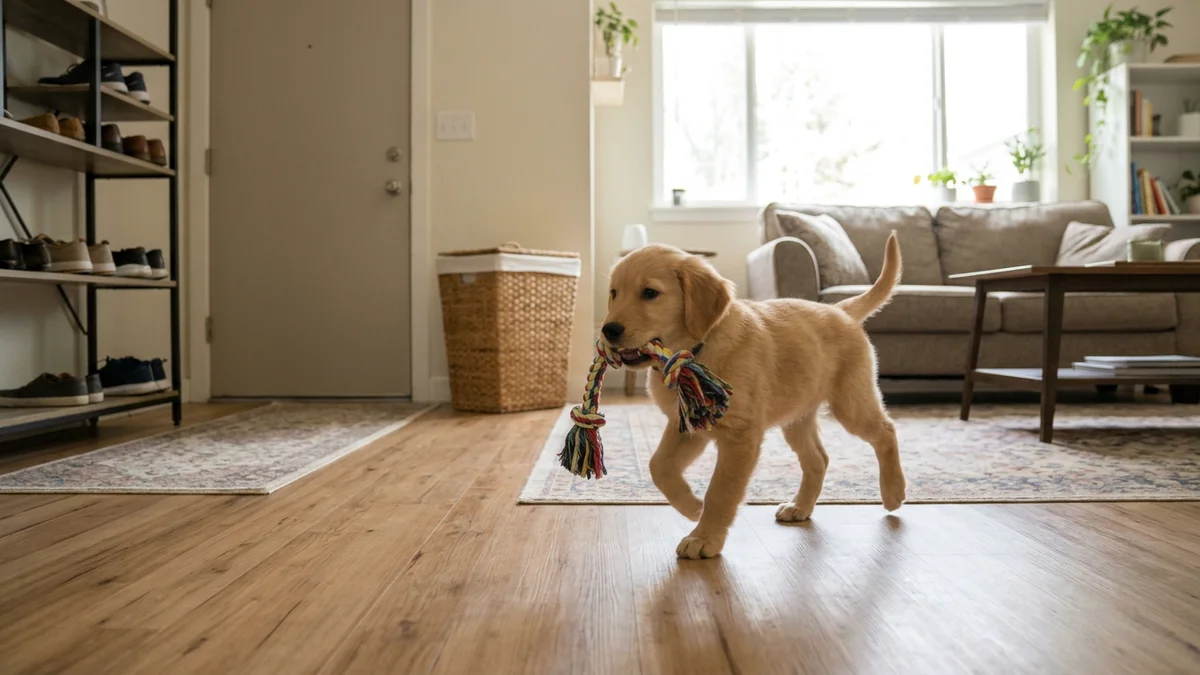
Give your puppy a variety of chew toys made for dogs, notice which ones keep them chewing longest, and offer more of those. The ASPCA suggests rotating toys, or bringing out something new, every couple of days so your puppy doesn’t get bored with the same ones.
- Chew toys. See our picks of the best puppy chew toys, and the best dog toys for aggressive chewers if your puppy shreds toys fast.
- Bones: ask your vet first. Cooked bones, like leftover T-bones or chicken wings, can splinter and seriously injure a dog (ASPCA). Never give cooked bones, and ask your vet before giving your puppy any bone.
- Edible chews only while you watch. Dogs can choke on edible chews, especially if they bite off and swallow large pieces. Stay with your puppy while they chew one, and give it away from other dogs so they don’t feel they have to gulp it down (ASPCA).
- No old shoes or cushions. It isn’t fair to expect a puppy to learn that some shoes are okay to chew and others aren’t (ASPCA).
For teething, some people give toys made to be frozen, or a frozen wet washcloth, which the ASPCA says might help numb teething pain. Stay with your puppy while they chew a washcloth, so it doesn’t get swallowed.
How do I stop my puppy chewing everything?
You don’t stop chewing. You steer it: make the wrong things hard to reach, make the right things easy and interesting, and watch your puppy closely until good habits set in. The ASPCA is clear that the right toys alone aren’t enough. Puppies also need to be taught, gently, what they can and can’t chew.
- Puppy-proof your home. Keep shoes and clothes behind a closed door, dirty laundry in a hamper and books on shelves (ASPCA). Tuck cords out of reach and use bins with lids. Make it easy for your puppy to get it right.
- Supervise, or confine safely. Keep your puppy in sight while they’re awake and loose. When you can’t watch, use a crate or a small puppy-safe room behind a baby gate, with nothing in it they shouldn’t chew and plenty they can (ASPCA). Keep crate time short and build it up slowly: our crate training guide shows how.
- Hand over a puzzle toy at chewing times. Notice when your puppy chews most, and give them a puzzle toy filled with something tasty at those times. Part of their daily food can go in it (ASPCA). For ideas, see our best dog puzzle toys.
- Exercise body and brain. Play, short training sessions and outings all count (ASPCA). If you have to leave your puppy alone for more than a short time, play with them first (ASPCA). Our puppy schedule shows how to fit this into the day.
- Bitter spray goes on objects only. The ASPCA says you can spray a chewing deterrent on things you don’t want chewed, and that a deterrent alone won’t solve chewing. Spray objects, never your puppy’s mouth, and always give the right chew alongside.
If your puppy chews everything except their toys, make the toys worth it. Rotate them every couple of days so they feel new, and offer more of the kinds that keep your puppy busy longest (ASPCA). Play with a toy for a minute before you hand it over, and praise your puppy when they pick it up. A toy with you on the other end is more interesting than one lying on the floor.
My puppy steals things and runs away: what do I do?
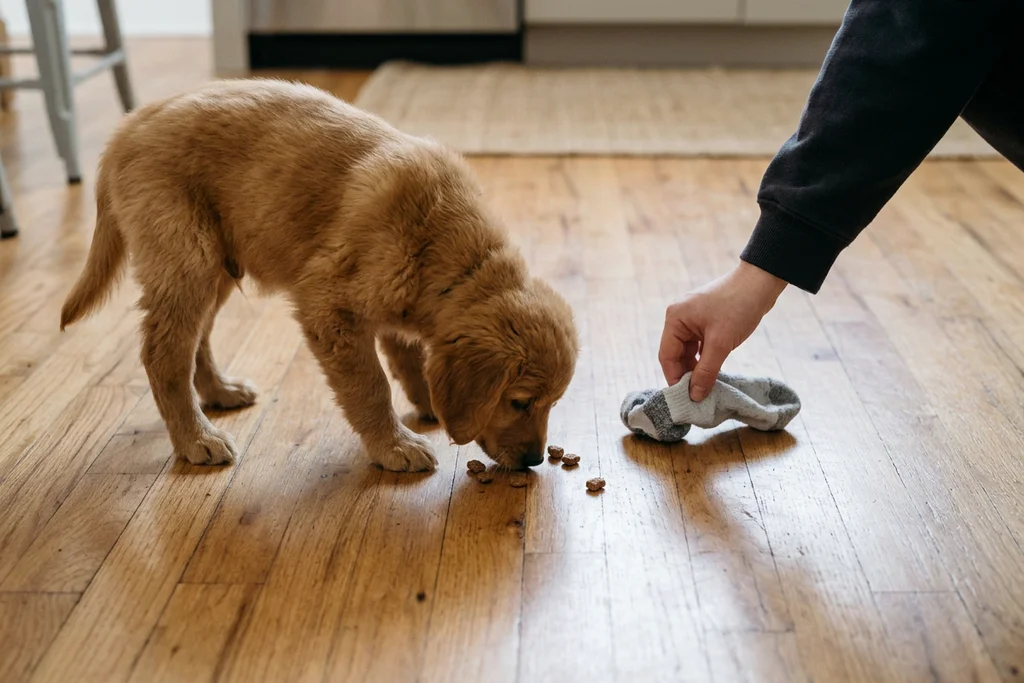
Don’t chase. A chase can turn grabbing into your puppy’s favorite game. Trade instead: offer something better, reward the drop, and give the item back if it’s safe.
- Skip the chase. Toss a few treats on the floor away from the item, and calmly pick it up while your puppy eats.
- Teach a trade before you need it. With a toy your puppy likes, hold a treat at their nose. When they let go, say “yes,” give the treat, then hand the toy back. Most trades should end with the toy coming back, so letting go stays a good deal.
- Add a cue. Once the trade is easy, say “drop it” just before you offer the treat. Practice with toys in short sessions, long before you need it for a shoe.
- Keep it kind. Teach with rewards, never by scolding, grabbing or prying. The American Veterinary Society of Animal Behavior (AVSAB) lists “increased anxiety and fear-related aggression” among the fallout of aversive methods (AVSAB, 2021).
If your puppy stiffens, freezes, growls or snaps when you come near something they have, stop and give them space. That can be resource guarding, and our resource guarding guide explains what to do. The ASPCA advises getting help from a qualified behavior professional if you think your dog might react aggressively when you take something away.
My puppy eats everything outside: what helps?
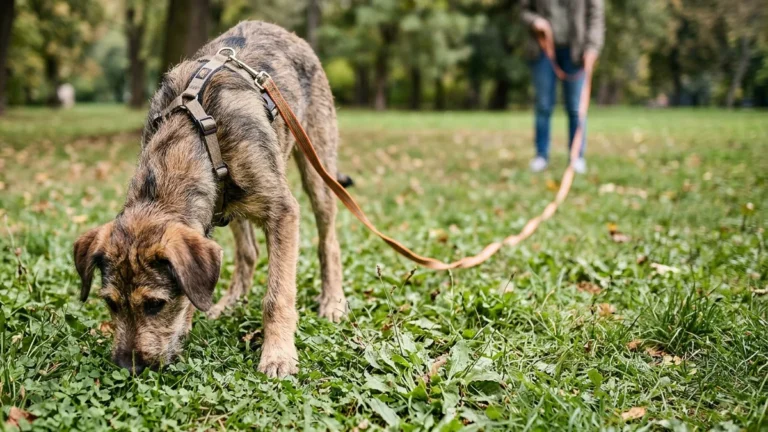
Outside, your puppy explores with their mouth too: sticks, stones, leaves and litter. Manage first, so there’s less to grab, then teach your puppy to leave things and to trade for what they pick up. Anything swallowed goes to the vet (see the next section).
- Manage first. Keep the leash short past litter and food scraps, and walk your puppy around the worst spots. In your yard, pick up what you can before your puppy goes out.
- Teach “leave it” at home. Hold a treat in a closed hand. The moment your puppy backs off, even for a second, say “yes” and give a treat from your other hand. Build it up slowly, then practice on walks.
- Trade, don’t wrestle. If your puppy picks something up, use the same trade as indoors: toss treats away from it and pick it up calmly.
- Give the nose a job. Short sniffing games and a little training on walks give your puppy something to do besides hunting for snacks on the ground.
My puppy swallowed something: what should I do?
Call your vet now, even if your puppy seems fine. Don’t wait for signs, don’t try a home remedy, and don’t try to make your puppy sick at home. Tell the vet what your puppy swallowed and when, and mention anything missing from your home, such as a toy: the Merck Veterinary Manual says this can be important.
Merck explains that swallowed objects can block a dog’s stomach or intestines, and that young, large-breed dogs are more likely to have a blockage from something they ate. Dogs with this kind of blockage tend to do well if it’s diagnosed and treated quickly. That’s why the call comes first.
Signs of a blockage include vomiting, low energy, not eating, and a sore or swollen belly (Merck). If you see any of them, go to the vet straight away. The signs are a reason to go, never a checklist to wait for: a puppy who swallowed something should see the vet before any sign appears.
Keep bins closed, too. The ASPCA warns that a sanitary pad or tampon taken from the trash can expand as it moves through a dog’s digestive system, which can be very dangerous. Use a lidded bin your puppy can’t open or tip.
What not to do
Some old advice about chewing is cruel, and none of it teaches your puppy anything. The ASPCA lists these:
- Don’t punish after the fact. Don’t show your puppy the damage and then scold or punish them. They can’t connect it with something they did hours, or even minutes, ago.
- Don’t tape your puppy’s mouth shut around a chewed object, or tie a chewed object to them. Both are inhumane and teach nothing, and the ASPCA says dogs have died from the taping.
- Don’t muzzle your puppy to stop chewing.
- Don’t leave your puppy in a crate for long stretches to stop chewing.
Harsh corrections of any kind can also add fear (AVSAB, 2021).
FAQ: puppy chewing
Is it normal for a puppy to chew everything?
Yes. Chewing is normal for dogs of all ages, and puppies chew even more while they explore with their mouths and their adult teeth come in (ASPCA). What matters is what they chew. Puppy-proof your home, give a variety of chew toys, watch your puppy closely, and trade for anything they shouldn’t have.
When do puppies stop chewing everything?
The ASPCA says the intense teething phase usually ends by about six months, and that most young dogs grow out of raiding laundry and bins as they mature. Chewing itself never stops: dogs chew all their lives, and the ASPCA says it keeps their jaws strong and teeth clean. Keep giving the right things to chew, and keep shoes and laundry out of reach.
What can puppies chew on for teething?
Chew toys made for dogs, rotated every couple of days so they stay interesting (ASPCA). Some people also give toys made to be frozen, or a frozen wet washcloth, which the ASPCA says might help numb teething pain. Stay with your puppy while they chew a washcloth. Never give cooked bones, and ask your vet before giving your puppy any bone.
Why does my puppy chew everything except toys?
Your shoes may simply be more interesting than the toys on the floor. Notice which toys keep your puppy chewing longest and offer more of those, and rotate toys every couple of days (ASPCA). Put shoes and laundry away, play with a toy for a minute before you hand it over, and praise your puppy when they choose it.
My 8-month-old puppy started chewing everything again: why?
At 8 months your puppy is an adolescent (about 6 months to 2 years), and our adolescent dog guide covers this stage. The ASPCA names boredom and too little physical or mental exercise among the reasons dogs chew, so check those first, and go back to puppy-proofing and supervision. If the chewing is sudden, comes with other changes, or happens mostly when your dog is alone, ask your vet.
Next steps
If your puppy bites hands and clothes as well as chewing things, our guide to how to stop puppy biting covers that side. For the rest of your puppy’s training, see our puppy training guide.
Sources
- ASPCA. Destructive Chewing (no date on the page; read Nov 3, 2026). aspca.org.
- Merck Veterinary Manual, pet owner version. Disorders of the Stomach and Intestines in Dogs, by Alice Defarges, DVM, DACVIM (full review May 2018). merckvetmanual.com.
- American Veterinary Society of Animal Behavior (AVSAB). Humane Dog Training position statement (2021). avsab.org/resources/position-statements.
Sandie Calloway is the pen name of the Smarter Paws Academy team. How we write