Smarter Paws Academy
Last updated: November 2026
This guide was written by the Smarter Paws team with AI help. Its sources are linked on this page.
Quick answer
Resource guarding is when a dog uses its body, a growl, a snap or a bite to keep hold of something it values. Researchers define it as “the use of avoidance, threatening, or aggressive behaviors by a dog to retain control of food or non-food items in the presence of a person or other animal” (Jacobs et al., 2018).
It’s common, and it’s normal dog behavior. Guarding valued things comes naturally to dogs. It becomes a problem when it’s aimed at people (ASPCA). A 2026 study calls resource guarding common in companion dogs and a risk to human safety (Rausch et al., 2026).
In a puppy, the plan is to add, never take. Teach your puppy that a person coming near their food or chew means something better is on the way.
Never punish a growl. A growl is a warning. It tells you to step back and change the plan.
Any bite, or guarding of people, goes to your vet and a qualified behavior professional. So does a growl that is getting worse.
What is resource guarding?
A dog guards what it values. That can be food, a chew or bone, a toy, a stolen sock, a resting spot or a person. What counts as valuable varies from dog to dog (ASPCA).
It ranges from mild to dangerous. At the mild end, a dog runs off with a prize or growls as someone comes near. At the serious end, it bites or chases a person away (ASPCA).
Who the dog guards from varies too. Some dogs guard only from certain people, often strangers. Others guard from everyone. Some guard from the other dogs in the home (ASPCA).
It can start in the litter. Puppies compete with their littermates for milk and food. In a 2026 survey of 293 dog breeders in Canada and the US, 61.4% saw littermates compete around the food bowl (Rausch et al., 2026).
Signs of resource guarding
The early signs are quiet, so they’re easy to miss. Watch for these when someone walks near your dog’s food, chew or toy (ASPCA; Rausch et al., 2026):
- Eating faster, or gulping
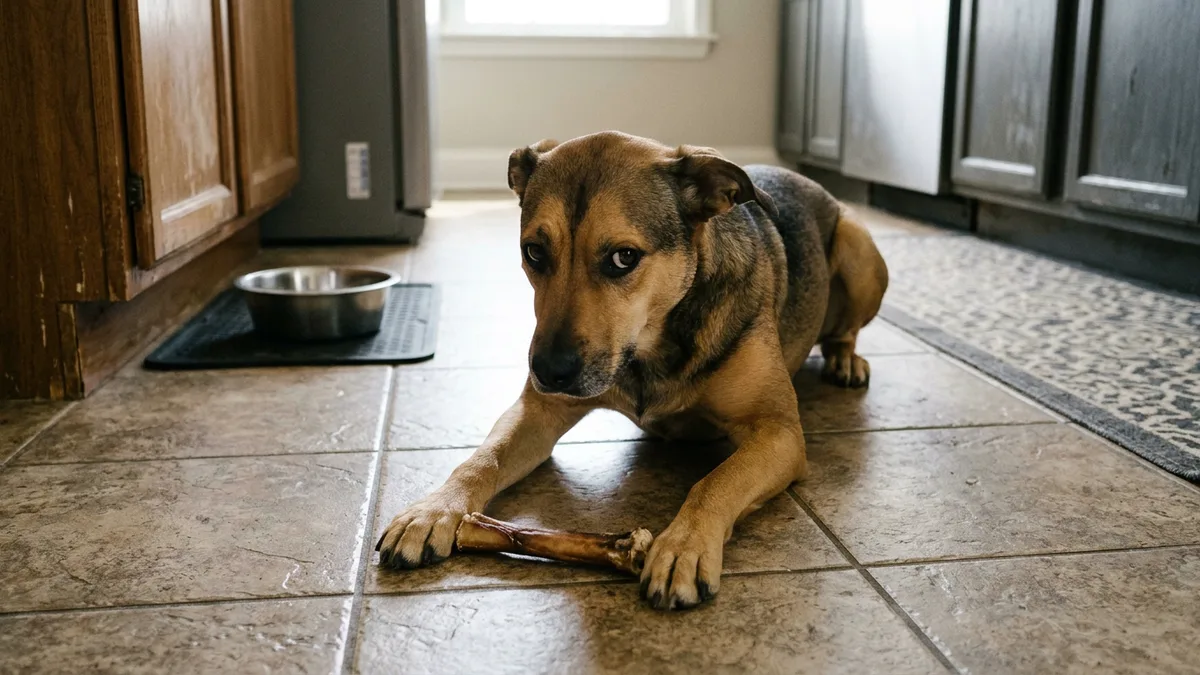
- Body blocking: turning or leaning to put their body between you and the item
- Going stiff, or freezing over the item
- A hard stare
- Running off with the item
- Growling
- Snarling (a lifted lip)
- Snapping or biting
The list runs from mild to serious. If you see snapping or biting, go straight to When to get help.
Resource guarding in puppies
Toward people, breeders saw it most around toys. In the 2026 breeder survey, 42.3% reported puppies competing with people around toys, and 22.2% around the food bowl. The behaviors ranged from body blocking and avoidance to threats and aggression (Rausch et al., 2026).
It shows up in young pet dogs too. In a study that followed young dogs in the UK and Ireland, owners named resource guarding as a problem for about 1 in 100 dogs at every check from 6 to 18 months (Kinsman et al., 2025). Owners described problems in their own words, so this counts only the owners who named it.
Is it normal for a puppy to growl over a bone? It’s common, and it’s worth acting on now. A play growl during tug comes with a loose, bouncy body. A growl over a bone, with a stiff body or a freeze, is a warning: your puppy wants to keep it. Our puppy biting guide shows the difference between play and warning signs.
How to prevent resource guarding in a puppy
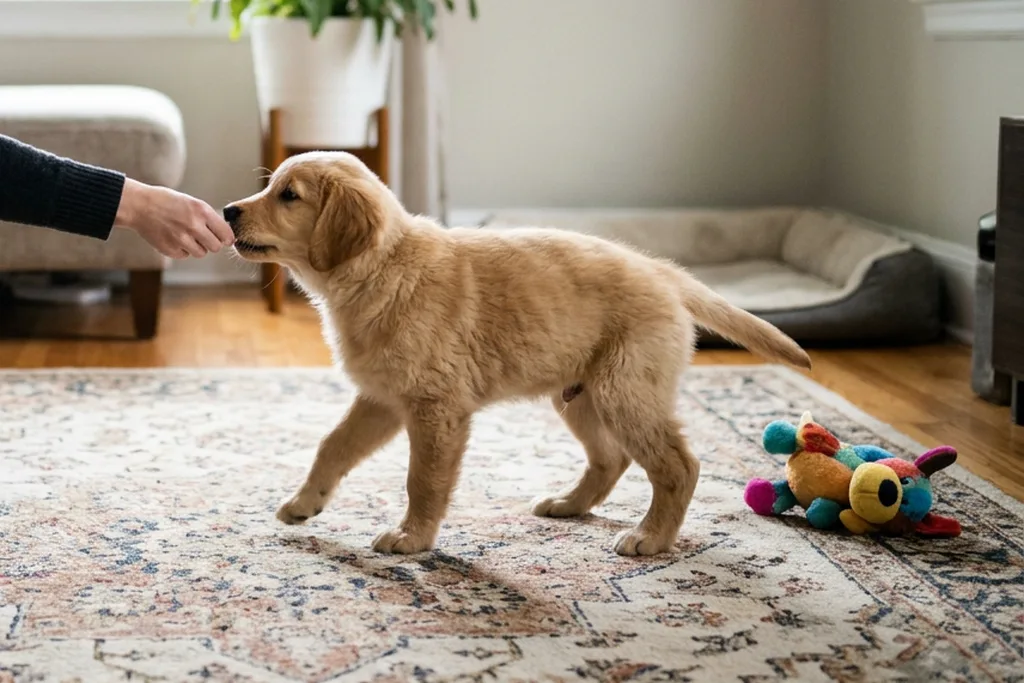
The goal: your puppy learns that a person near their things means good things arrive. Every step below adds something for your puppy. This is positive reinforcement at work: the behavior you reward is the one you see more of.
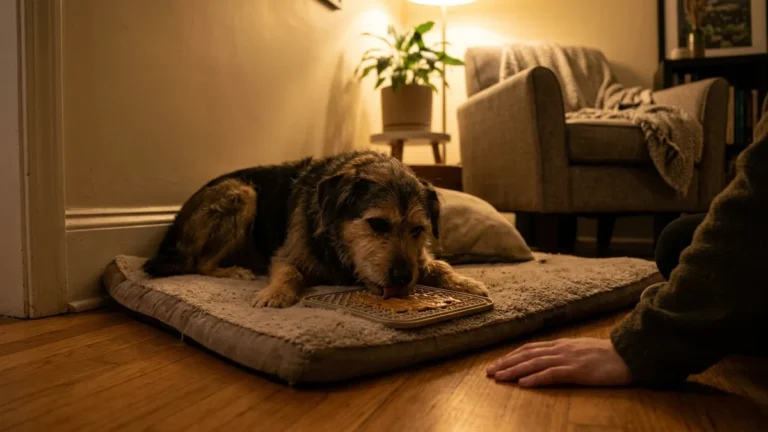
- Drop in something better. While your puppy eats, walk past and drop a small bite of chicken or cheese into the bowl, then walk on. Do it now and then for the first few months at home (ASPCA).
- Teach a trade. Hold a treat at your puppy’s nose. When they let go of the toy, say “yes,” give the treat, then hand the toy back. Most trades should end with the toy coming back, so letting go stays a good deal.
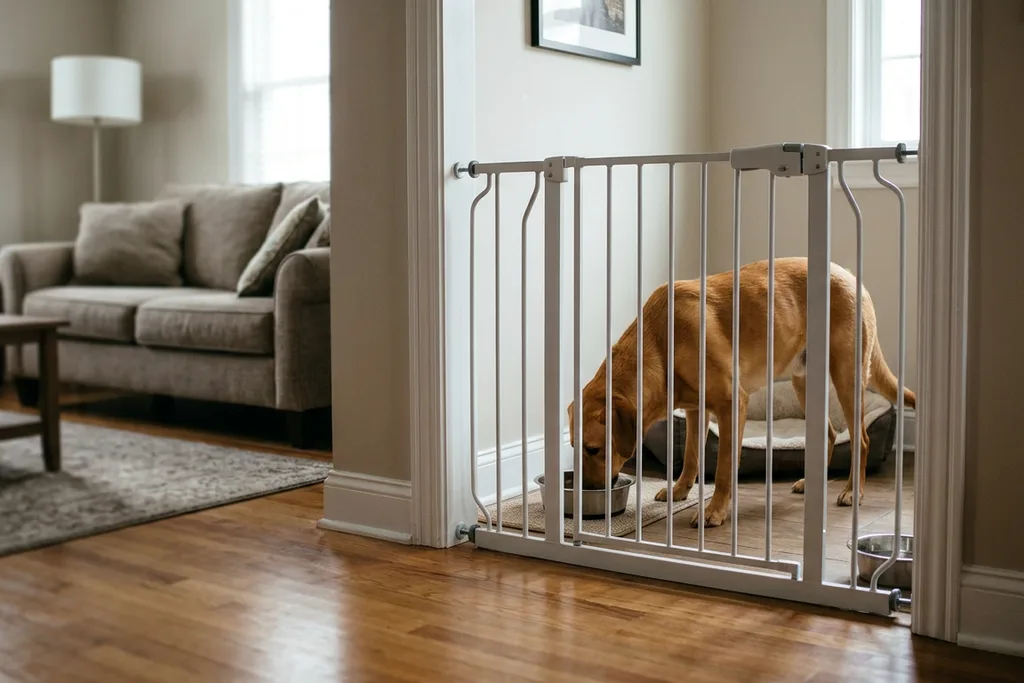
- Let them eat in peace. Feed in a quiet spot: a crate, a separate room or behind a baby gate. Keep children and other dogs away from the bowl (ASPCA).
- One of everything per dog. Separate bowls, chews and beds, and pick up high-value chews when the dogs are together. Our guide to introducing two dogs covers the first weeks.
- Skip the chase. If your puppy grabs a sock, toss a few treats on the floor away from it, and pick the sock up while they eat. If they may have swallowed something harmful, call your vet now.
- Leave the bowl alone. Reaching in to “test” your puppy, or taking food away to show who’s in charge, is dangerous and can make guarding worse (ASPCA).
Does resource guarding go away?
It can improve, and a label isn’t a life sentence. In a 2020 study of shelter dogs, more than half of the dogs called resource guarders by shelter staff or by their former owners didn’t guard in their new homes (McGuire et al., 2020).
Most cases are mild. In an earlier study at the same New York shelter, 15% of dogs were identified as resource guarders, and most of them showed mild to moderate guarding (McGuire, 2019).
Start now. No study we found measures how often guarding fades by itself, so begin the steps on this page today.
Management counts as a fix. Many owners of food guarders keep everyone safe with simple precautions: they leave the dog alone while it eats, feed it in a crate or a separate room, and never take away scavenged food (ASPCA).
Training helps mild food guarding. The ASPCA describes the treatment, desensitization combined with counterconditioning, as highly effective but fairly complex. In outline, for a dog who has never snapped or bitten:
- Stand far enough away that your dog keeps eating calmly.
- Toss a special treat toward the bowl, then walk away.
- Over many meals, start a step closer, only while your dog stays relaxed.
- Each adult in the family then repeats the steps from the start (ASPCA).
If your dog stiffens, freezes, growls, snarls or snaps during these steps, stop and get help from a qualified behavior professional (ASPCA). Children never do these steps.
What not to do
- Never punish a growl. A growl is your dog’s warning. The American Veterinary Society of Animal Behavior (AVSAB) lists “increased anxiety and fear-related aggression” among the fallout of aversive methods (AVSAB, 2021).
- Don’t take things away to “show who’s boss.” The ASPCA calls this dangerous and unnecessary, and says it can make guarding worse.
- Don’t use choke chains, prong collars, shock collars or physical corrections. AVSAB says trainers should avoid tools that involve pain, and that dogs with aggression need humane methods: “There are no exceptions to this standard.”
- Don’t let children near a guarding dog while it eats or chews. The ASPCA warns against doing the training with any child under 18.
When to get help
These lines have no exceptions.
- Any bite, or any snap at a person: stop the training on this page. Book your vet first, then a qualified behavior professional.
- Guarding of people: if your dog growls, snaps or bites to keep a person away from its things, or guards a person (growling when someone comes near you on the couch), get the same help.
- A growl that’s getting worse: more often, louder, over more things, or closer to a snap. Get help now, before there’s a bite.
- Children at home: if your dog guards anything and children live with you or visit, keep them apart while the dog eats or chews, and get professional help. Children are more likely to be bitten because they find a dog’s warning signals harder to read (ASPCA).
- Fights between your dogs: feed them apart, pick up chews and toys, and get a qualified behavior professional to help.
Why the vet comes first. AVSAB says dogs with serious behavior problems such as aggression should always be evaluated by a veterinarian, so an accurate diagnosis and treatment plan can be made and medical causes can be ruled out (AVSAB, 2021).
Who counts as a qualified behavior professional: a board-certified veterinary behaviorist (DACVB), a certified applied animal behaviorist (CAAB), or a reward-based trainer with education and experience in treating aggression. Ask about that experience: the ASPCA notes that it isn’t required for a trainer’s CPDT certification. AVSAB’s How to Choose a Trainer lists what to look for.
FAQ: resource guarding
Does resource guarding ever go away?
It can improve with management and reward-based training, and a label from one setting can change. In a 2020 shelter study, more than half of the dogs called resource guarders by staff or former owners didn’t guard in their new homes (McGuire et al., 2020). Start the prevention steps now. If your dog has bitten, or guards against people, see your vet and a qualified behavior professional.
Is resource guarding dangerous?
It can be. It ranges from running off with a toy to biting, and children are most at risk because they find a dog’s warnings harder to read (ASPCA). In a New York shelter study, most guarders showed mild to moderate guarding (McGuire, 2019). Treat every growl as a warning, never punish it, and involve your vet and a qualified behavior professional after any bite.
How common is resource guarding?
Common. In a study at a New York shelter over nearly five years, 15% of dogs were identified as resource guarders during behavior evaluations (McGuire, 2019). Guarding was more common in adult and senior dogs there than in young ones. Shelter dogs differ from pet dogs at home, so treat the number as a rough guide, and start prevention while your dog is young.
Is it normal for puppies to growl over a bone?
It’s common, and worth acting on early. In a 2026 survey of 293 breeders, 42.3% reported puppies competing with people around toys, from body blocking to threats (Rausch et al., 2026). Use the steps above: walk past, drop in something better, walk on. If the growling gets worse, or your puppy snaps or bites, call your vet and a qualified behavior professional.
How do you stop resource guarding between dogs?
Start with management: feed the dogs apart, give each one its own chews and bed, and pick up high-value items when they’re together. Competition starts early: in a 2026 breeder survey, 61.4% saw littermates compete around the food bowl (Rausch et al., 2026). If your dogs have fought, or one keeps threatening the other, get a qualified behavior professional to help.
How does resource guarding start?
Guarding valued things is normal dog behavior, and puppies compete for food from the start. In a 2026 breeder survey, 71.6% saw littermates compete for nipples while suckling (Rausch et al., 2026). The ASPCA notes that a puppy who wins food by pushing littermates away can carry that habit home. At home, taking things away by force can make guarding worse.
Sources
- Jacobs JA, Coe JB, Widowski TM, Pearl DL, Niel L. Defining and clarifying the terms canine possessive aggression and resource guarding: a study of expert opinion. Frontiers in Veterinary Science. 2018;5:115. doi:10.3389/fvets.2018.00115. Open access.
- Rausch, White, Widowski, Coe, Jacobs, Niel. Resource management practices of Canadian and American domestic dog breeders and associations with puppy competitive behaviour: a cross-sectional study. Animal Welfare. 2026;35:e42. doi:10.1017/awf.2026.10098. Open access.
- Kinsman R, Casey R, Tasker S, Cooper B, et al. Owner-perceived undesirable behaviours in young dogs and changes with age. Animals. 2025;15(8):1163. doi:10.3390/ani15081163. Open access.
- McGuire B. Characteristics and adoption success of shelter dogs assessed as resource guarders. Animals. 2019;9(11):982. doi:10.3390/ani9110982. Open access.
- McGuire B, Orantes D, Xue S, Parry S. Abilities of canine shelter behavioral evaluations and owner surrender profiles to predict resource guarding in adoptive homes. Animals. 2020;10(9):1702. doi:10.3390/ani10091702. Open access.
- ASPCA. Food Guarding. aspca.org.
- American Veterinary Society of Animal Behavior (AVSAB). Humane Dog Training position statement (2021), and How to Choose a Trainer. avsab.org/resources/position-statements.
Sandie Calloway is the pen name of the Smarter Paws Academy team. How we write