Smarter Paws Academy
Quick answer
To calm an anxious dog right now, move them away from what scares them, give them a quiet spot, and offer an easy job like sniffing for scattered treats. For lasting change, work out what triggers the anxiety, build a predictable routine, and teach your dog, step by step and with rewards, that those triggers predict good things.
Never punish a scared dog, and never force them to face the thing they fear up close. Both can make fear worse.
See your vet first if the anxiety is new, sudden or getting worse. Pain and illness can sit behind anxious behavior, and only your vet can rule them out.
How do you tell if a dog has anxiety?
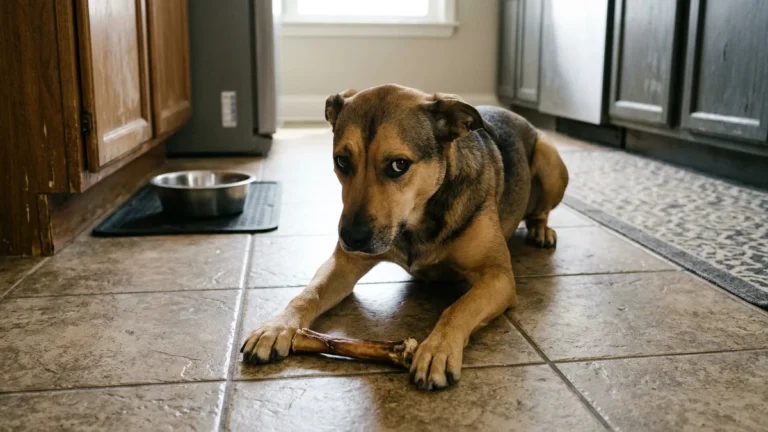
Anxiety in dogs usually starts small. Early signs are easy to miss: lip licking, panting, and ears pulled back (Cornell University College of Veterinary Medicine; AKC). The AKC’s advice is to act at these early signs, before the stress builds.
When it’s too much, the signs get bigger: shaking, pacing, drooling, hiding, or trying to escape. Some dogs chew or dig at doors, walls or floors (ASPCA).
Signs and what to do
| What you see | What it means | What to do |
|---|---|---|
| Lip licking, panting, ears back | Your dog is starting to feel uneasy | Add distance from the trigger and offer an easy sniff game |
| Hiding, pacing, shaking | Your dog is scared | Let them go to their quiet spot. Keep things calm and stop any training |
| Drooling, trying to escape, chewing or digging at doors | Your dog is past coping | Keep them safe from doors and anything they could swallow. If it happens often, call your vet |
Keep a note of what happened just before. Our free printable trigger log makes that easy (see the long-term plan below).
What causes anxiety in dogs?
Anxiety is rarely a simple diagnosis, and something usually sits behind it, according to Cornell’s veterinary college. It can show up as:
- trouble being left alone (see our guide to dog separation anxiety);
- guarding food, toys or places;
- barking or lunging at people or other dogs at home or on walks (see why a dog reacts to people and leash reactivity);
- fear of loud sounds, like storms;
- in older dogs, changes linked to an ageing brain, such as restless nights. Ask your vet about any change in a senior dog.
A health problem can look like a behavior problem, so the AKC’s advice is to have your vet rule out medical causes first.
A move to a new home is a big change too. For a newly adopted dog, many shelters use the “3-3-3 rule” as a rough guide (see the FAQ).
Early life plays a part. A puppy who meets the world gently and with good things is better set up for life, which is why puppy socialization matters so much.
How to calm an anxious dog right now
- Make distance. Move your dog away from what’s scaring them, or remove the trigger if you can.
- Offer a quiet spot. A calm room or a covered bed, with less noise. If your dog chooses a hiding place, let them stay there (ASPCA).
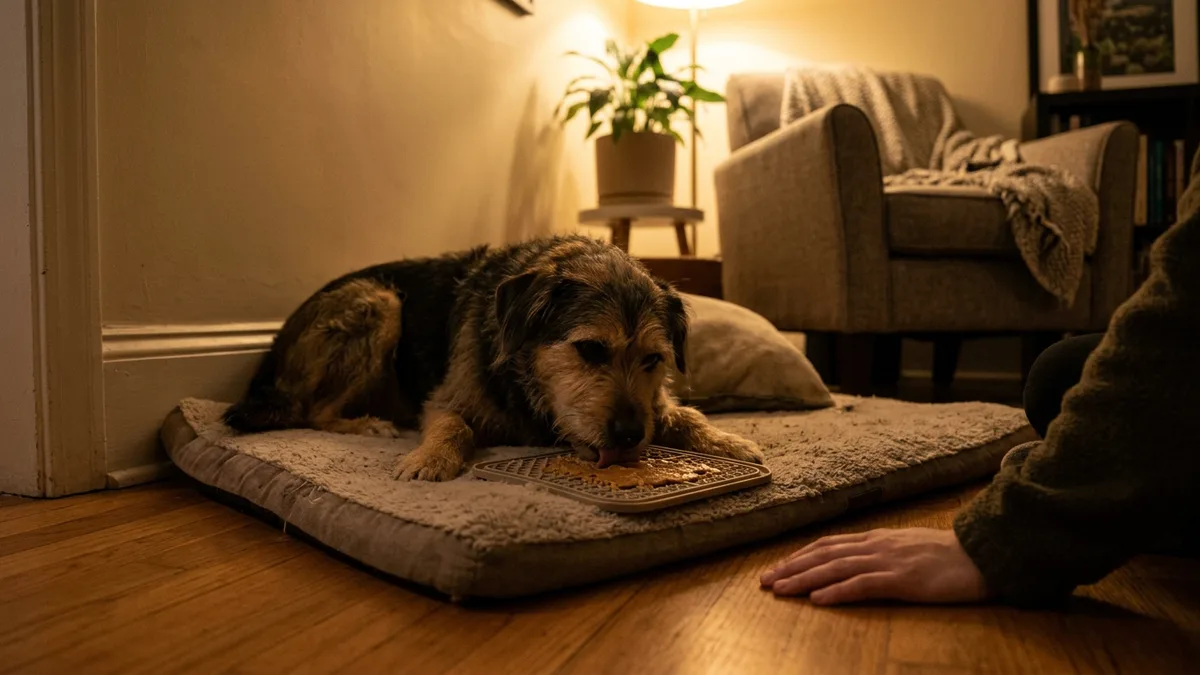
- Give an easy job. Scatter a few treats on the floor for your dog to sniff out, or offer a lick mat or a food puzzle. The AKC names scatter feeding, snuffle mats and lick mats among its calming games.
- Stay calm yourself. A slow, quiet voice and slow movements help. The ASPCA notes that dogs pick up on your mood.
- Skip the lesson. This is not the moment to teach anything new. Wait until your dog has settled.
Never punish a scared dog, and never drag them toward what they fear. Fear is not disobedience. Punishment and force can add to the fear (AVSAB).
How to help a dog with anxiety for the long term
Calming a dog in the moment gets you through the day. Lasting change takes a plan.
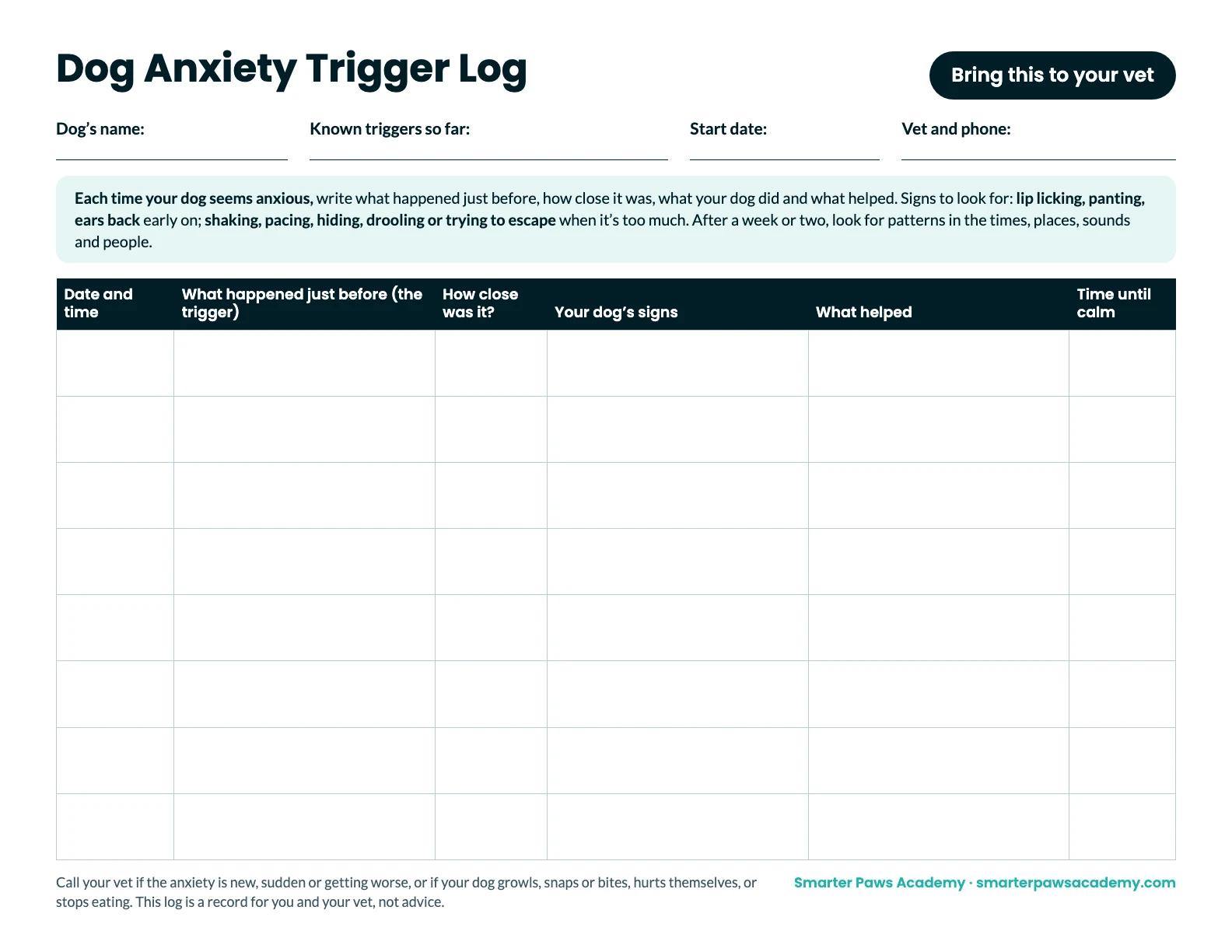
1. Find the triggers. Write down what happens just before your dog gets anxious: the time, the place, how close the trigger was, what your dog did, and what helped. After a week or two, patterns show up. Our free printable trigger log has a column for each of these: Download the dog anxiety trigger log (PDF), print it, and bring it to your vet too.
2. Make the day predictable. Regular times for meals, walks, play and rest help anxious dogs feel safe (Cornell; AKC). A daily schedule works for adult dogs too.
3. Build a safe spot. Teach your dog that one mat or bed is the place where good, calm things happen, and reward them for settling there. A crate can be that spot for a dog who already likes it (Cornell). See how to crate train a puppy for the slow, rewarding way to get there.
4. Teach a “relax” routine. The AKC describes teaching a dog to relax on cue in small steps. Practise when your dog is already calm, not when they’re scared.
5. Give the brain a job. Food puzzles, sniff games and long-lasting chews give an anxious dog something calm to do. See our picks for puzzle toys and tough chews.
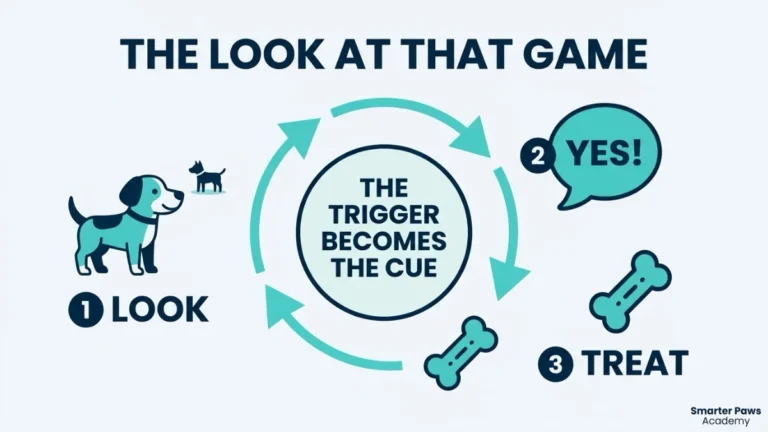
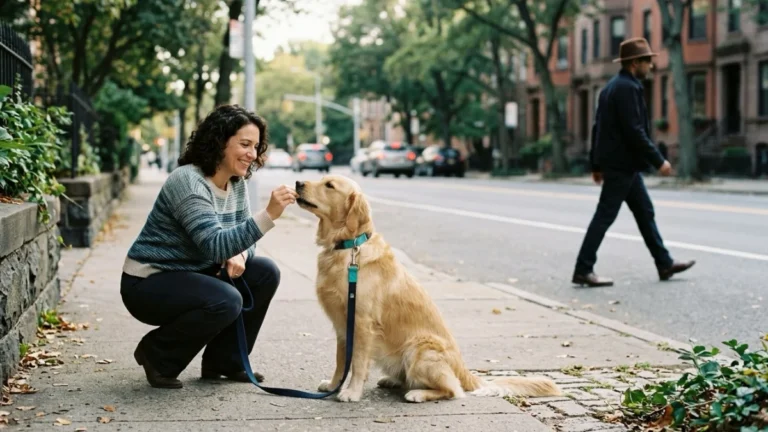
6. Change how your dog feels about the trigger. This is desensitization and counterconditioning: show the trigger at a distance where your dog stays relaxed, pair it with something great like food, and only move closer as your dog stays easy (Cornell; AKC). The Look at That game is one way to start. Go slowly. If your dog reacts, you moved too close or too fast.
7. Get help early. If progress stalls, or your dog’s fear is strong, a qualified behavior professional who uses positive reinforcement can build the plan with you (AKC; Cornell).
What makes anxiety worse: punishment, harsh corrections and pain tools, and “flooding” (forcing a dog to stay close to what it fears until it stops reacting). The AVSAB lists increased anxiety and fear-related aggression among the fallout of aversive methods, and the AKC warns against flooding.
How to calm an anxious dog during a thunderstorm or fireworks
Storm fear is common in dogs. It may be the noise, the flashes of light or the change in air pressure, and it’s hard to know which, so it may be more than one (ASPCA). For fireworks and other loud noises, the ASPCA’s advice is much the same: an inner room without windows, soft music, and a snug vest (ASPCA on fireworks).
A storm or fireworks night plan:
- Before the storm or the fireworks, set up a safe spot in an inner room, without windows if you can, where the noise and flashes are softer. Add a bed and a chew or food puzzle.
- Let your dog choose. If they want to hide under a bed or in a closet or bathroom, let them.
- Stay calm and keep them busy. Play a quiet game, put on the TV or soft music, or hand over a stuffed chew toy or food puzzle (ASPCA).
- Try a snug vest or shirt. The ASPCA says an anxiety vest may help some dogs, and a snug T-shirt is an option if you don’t have one. Not every dog likes one, so try it on a calm day first.
- Keep them safe. A scared dog may bolt out of a door, or chew and swallow things they shouldn’t. Close outside doors and keep anything harmful out of reach. Some dogs will even eat fireworks, so if you set any off at home, clean up the area well before your dog goes back out (ASPCA). If you think your dog swallowed something harmful, call your vet now.
One thing doesn’t work for every dog, so keep trying until you find what helps yours.
Storm fear can get worse with time. If your dog’s fear is moderate to severe, talk to your vet or a veterinary behaviorist. If your vet prescribes something for storm or fireworks nights, ask your vet about trying it first on a calm day, while the clinic is open, so you know how your dog responds (ASPCA). Never share it with another pet or give more than your vet’s dose.
What can I give my dog for anxiety?
Anxiety medicine comes from your vet, who checks your dog first. Your vet looks for health causes, then decides whether medicine is right alongside a training plan (Cornell; VCA). Don’t give your dog any human medicine or a remedy you read about online.
What you can give at home is calm and structure: a quiet spot, sniff games, a food puzzle or lick mat, and a steady routine. For non-drug aids, see our guide to calming products for dogs. They support a plan; they don’t replace one.
When to call your vet or a behaviorist
Call your vet if your dog:
- suddenly becomes anxious, or the anxiety gets worse;
- growls, snaps or bites, or shows any aggression;
- hurts themselves while scared, or breaks teeth or nails trying to escape;
- stops eating, or shows any sign of illness;
- is a senior and starts pacing or seems restless at night.
The AVSAB says dogs with serious fear, aggression or separation problems should always be checked by a vet, so medical causes can be ruled out. Your vet may then refer you to a veterinary behaviorist or a qualified behavior professional.
FAQ: anxious dogs
How long does it take to calm an anxious dog?
It takes time, and every dog is different. Your vet or a veterinary behaviorist can tell you what to expect for your dog.
Can dog anxiety be cured?
Many anxious dogs become much calmer with a steady plan, and some fears fade a great deal. No plan comes with a guarantee, so think in terms of progress rather than a cure, and ask your vet what to expect.
Does a crate help an anxious dog?
It can, if your dog already sees the crate as a safe den (Cornell). If not, don’t shut a scared dog in. Let them choose their own hiding place, as the ASPCA advises for storms, and build up crate time slowly on calm days.
What does a dog anxiety attack look like?
Shaking, pacing, drooling, hiding or frantic attempts to escape (ASPCA). Keep your dog safe, lower the noise and light, and stay calm. If it happens often, lasts a long time, or your dog hurts themselves, call your vet.
What is the 3-3-3 rule for dog anxiety?
It’s a rough guide shelters give for a newly adopted dog: the first 3 days, they may feel lost, nervous or overexcited; by 3 weeks, they start to settle and show their personality; by about 3 months, they feel at home, and nervous animals may take longer (SPCA de Montréal). Every dog is different. If your new dog isn’t settling after about 3 weeks, the SPCA de Montréal suggests asking a behavior professional for help early.
Sources
- Cornell University College of Veterinary Medicine, Riney Canine Health Center. Anxious behavior: How to help your dog cope with unsettling situations (last updated Dec 23, 2025). vet.cornell.edu.
- American Kennel Club. How to Help an Anxious Dog: Training Tips to Reduce Stress (Oct 8, 2026). akc.org.
- ASPCA. Weathering the Storm: How to Help Scared Pets During Storms (Sep 14, 2023). aspca.org.
- ASPCA. Here’s What to Do If Your Pet Is Scared of Fireworks (Jun 30, 2022). aspca.org.
- SPCA de Montréal. The 3-3-3 Rule for Adjusting to a New Home (Aug 16, 2024). spca.com.
- American Veterinary Society of Animal Behavior (AVSAB). Humane Dog Training position statement (2021). avsab.org/resources/position-statements.
- VCA Canada. Signs Your Dog is Stressed and How to Relieve It (updated Mar 24, 2025). vcacanada.com. Cited only.
Sandie Calloway is the pen name of the Smarter Paws Academy team. How we write